Architecture Overview
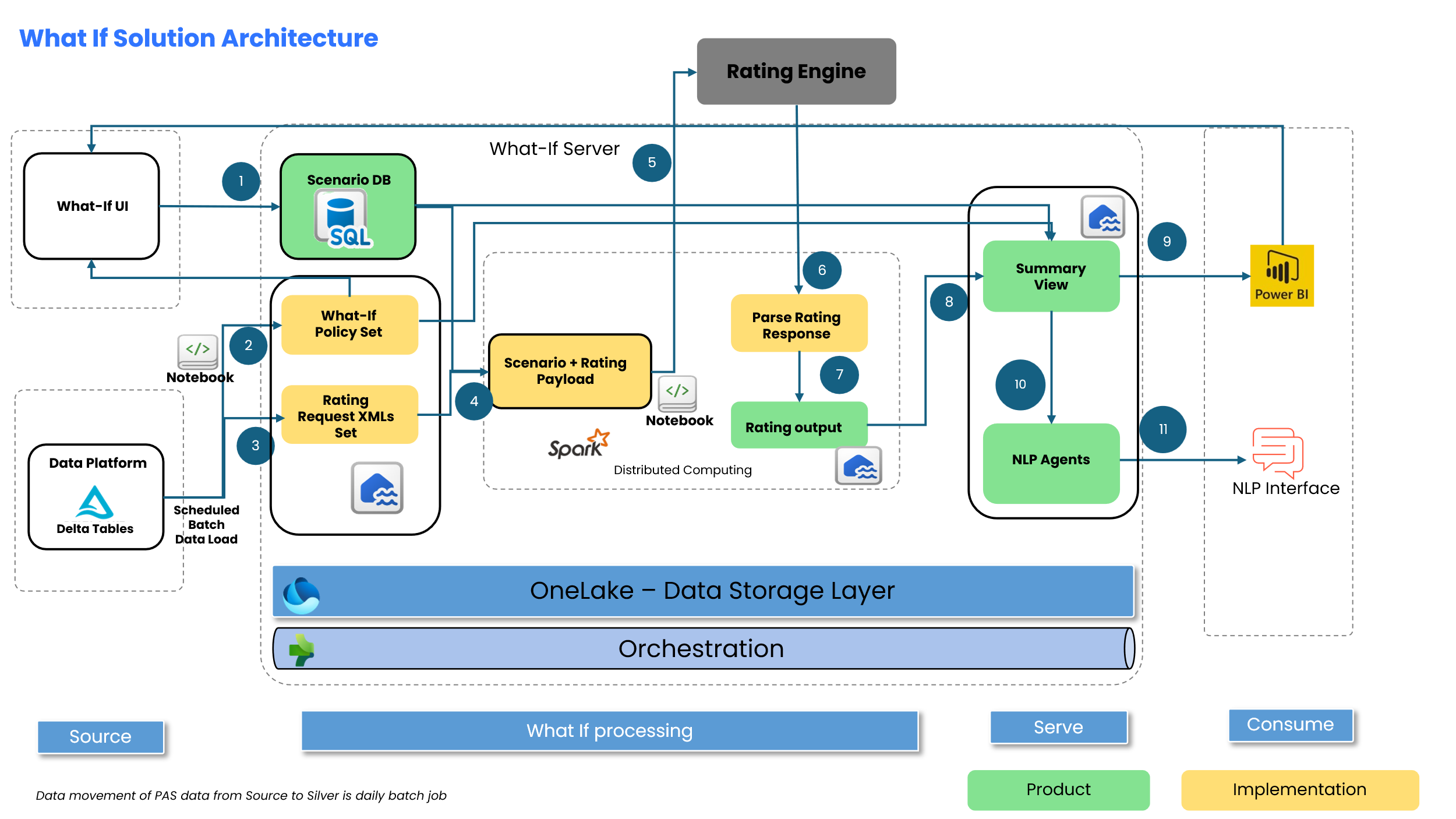
| Step | Description |
|---|---|
| 1 | Scenario Selection: Select specific "What-If" parameters through the UI |
| 2 | Policy Set Creation: Prepare the target policy data from the Data Platform |
| 3 | XML Transformation: Convert policy data into the required Rating Request XML format. |
| 4 | Payload Preparation: Combine scenarios and XML sets into a unified Spark distributed payload. |
| 5 | Rating Engine Call: Distribute and submit the payload to the Rating Engine for premium |
| 6 | Capture Response: Receive raw rating data back from the rating engine. |
| 7 | Standardize Output: Parse and transform the rating response into a standard format. |
| 8 | Prepare Summary: Aggregate the rating outputs and scenarios into a consolidated Summary View. |
| 9 | Report Refresh: Update Power BI dashboards with the latest What-If results. |
| 10 | NLP Agent Processing: Feed the summary data into NLP Agents for intelligent analysis. |
| 11 | End User Interaction: Provide insights via the NLP Interface (Genie/Chat) for user queries. |
Architectural Layers
The What-If Solution Architecture is organised into four horizontal layers that mirror a modern data platform pattern:
| Layer | Purpose |
|---|---|
| Source Ingestion | Origin systems and data ingestion Data Platform. |
| What-If UI Data | Scenario DB. |
| What-If Processing | Core computation layer - Spark notebooks, payload preparation, Rating Engine calls, response parsing, and standardisation. |
| Serve | Result aggregation and AI agent layer - Summary View and NLP Agents. |
| Consume | End-user consumption - Power BI dashboards and NLP natural-language interface. |
High-Level Data Flow
The diagram below (referenced from the What-If Solution Architecture diagram) shows the numbered 9-step flow from user scenario selection through to conversational result delivery. Each numbered circle in the architecture diagram corresponds to a process step described in detail.
Batch Process
Flow Summary
Deployment Topology
The solution is deployed within the Microsoft Fabric and Azure ecosystem:
- Microsoft Fabric Workspace hosts all Fabric SQL Database, Spark Notebooks, Lakehouses (OneLake), Pipelines, Power BI datasets, and datasets.
- The Rating Engine may be hosted on-premise, in Azure (IaaS/PaaS), or accessed via a third-party SaaS endpoint - the What-If Server abstracts the connectivity pattern.
- Power BI Service (via Fabric) serves the BI layer with enterprise-grade capacity and row-level security.